Delegation of African-American leaders visits Cuba on fact-finding and humanitarian mission
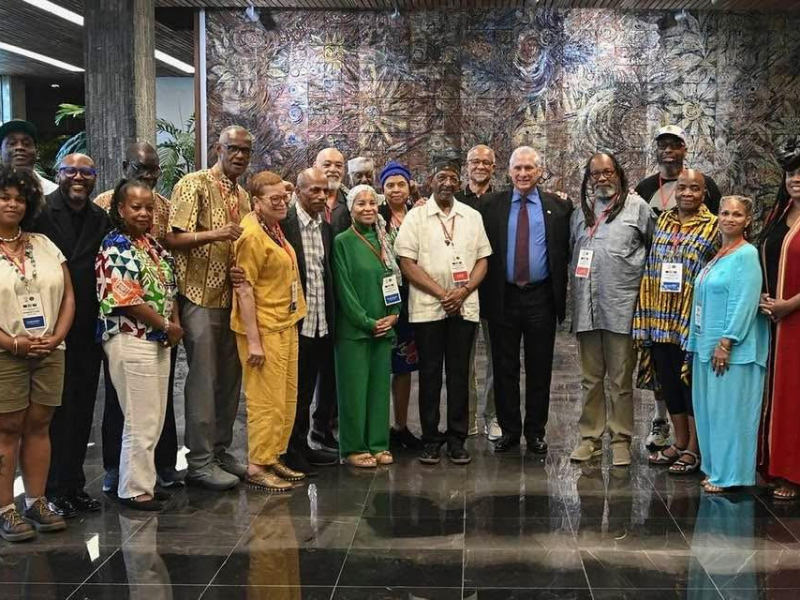
By Haki S. Ammi, Baltimore activist, IBW board member, and author.Twenty-three delegates from the United States, representing a broad cross-section of the Black community, participated in three full days of listening, seeing, and learning how the US blockade, sanctions, and escalating threats have deepened desperation and instability in Cuba.
The delegation was led by Dr Ron Daniels of the Institute of the Black World and curated by James Ealy. Both are national and international organisers with extensive experience in humanitarian efforts from Haiti to Grenada.
James Early, who has visited Cuba dozens of times over the past 50 years, acted as interpreter and liaison for the group, alongside writers from Amsterdam News, The Final Call, and the Washington Informer.
Upon arrival, the group hosted an informal meet-and-greet with other arriving delegates from across the US.
Many are aware that since Marco Rubio became Secretary of State, there has been an uptick in hostilities toward Cuba. Rubio was not born in Cuba – his family left the island, and he was born in Miami. Many speculate that Miami Cuban expatriate influencers are driving the policy of regime change. The recent indictment of Raúl Castro sets a dangerous precedent in human history: using the Justice Department for international diplomatic issues. Since the President of Venezuela, Nicolás Maduro, was effectively taken by US military forces, no oil has been received by Cuba.
This makes basic operations such as food preservation difficult as power outages occur throughout the day and night.
While there, the delegation visited a hospital. One of the most painful moments was witnessing a doctor break down in tears, explaining that sometimes the power goes out during surgeries.
Recently, Pastor Jamal Bryant said on a livestream that ICU patients in Cuba are all dying because they cannot keep power running.
Among the delegation from Baltimore was Rev. Dr Robert Turner of Empowerment Temple, who upon return preached on the power of gentle diplomacy. He saw firsthand how the heavy-handed US policy is causing tremendous damage to the Cuban people. Despite the hostilities, he said, he witnessed how much Cubans love Americans.
On April 28, Senator Angela Alsobrooks co-sponsored Senator Tim Kaine's S.J. Res 124, a resolution to direct the removal of United States Armed Forces from hostilities within or against the Republic of Cuba that have not been authorised by Congress.
On May 23, the Congressional Black Caucus issued a strongly worded letter to Marco Rubio and President Trump. Chairwoman Yvette Lewis wrote: "Under the administration's oil blockade and tightening of sanctions, Cubans are dying."
One of the highlights of the trip was a meeting with the current President of Cuba, Miguel Díaz-Canel. He gave a history lesson and spoke firmly, saying: "The Cuban people are being terrorised. They label us as oppressors of our people, but we have helped all our citizens with housing, education, and medical care."
The delegation also visited several other sites, including the National Assembly of People's Power, the Fidel Castro Museum, the Martin Luther King Centre, and the Latin American School of Medicine. The medical school has trained doctors from all over the world. Cuba developed five Covid-19 vaccines to protect its citizens. Cuba has also sent doctors around the world during Ebola outbreaks, deploying more than 250 doctors and nurses to nations such as Guinea, Liberia, and Sierra Leone.
Milton Allimadi, an author, expressed that South Africa, Angola, Nigeria, and Ghana should assist Cuba, noting that Cuba has been a friend to Africa, and now it is time for Africa to be a friend back to Cuba.